Living cookbooks for real life
The cookbook that keeps evolving.
Preserve recipes, branch versions, plan gatherings, and keep the stories around your food alive.
Ponics’ Pantry is built for the way cooking actually works — recipes change, people adapt them, traditions repeat, and the best versions are worth remembering.
Start free with no card required. See the cost before you sign up.
Explore Ponics’ Pantry
Start with the path that matches how you cook.
Where would Ponics’ Pantry help you most?
Different cooks come to Ponics’ Pantry for different reasons. The common thread is simple: keep the recipe, the change, and the story connected.
Keep family recipes alive
Preserve the original, branch family variations, and keep memories connected to the recipes people still talk about.
Stop losing what worked
Track recipe versions, cooking changes, and outcomes so the best version is easy to find again.
Plan recurring gatherings
Use Shared Spaces Events for holidays, tailgates, beach weeks, reunions, and other food traditions that come back every year.
Cook around real constraints
Branch gluten-free, higher-protein, lower-sodium, or weeknight-friendly versions without losing the original.
Organize scattered recipes
Bring in recipes from websites, social posts, photos, screenshots, copied text, and old collections.
Share recipes that keep growing
In Shared Spaces, others can fork recipes into their own kitchen while the lineage stays clear.
More than a recipe box
Most recipe tools treat a recipe like a card. Ponics’ Pantry treats it like something alive.
A recipe can have an original, a child version, a gluten-free branch, a holiday variation, a lighter weeknight version, or the one your tailgate crew keeps asking for.
Instead of overwriting what came before, Ponics’ Pantry keeps the family of versions connected so you can see where a recipe came from, what changed, and why one version became the keeper.
How it works
Ponics’ Pantry gives everyday cooks a structured way to bring recipes in, improve them, cook from them, and preserve what happened.
Bring recipes in
Import from websites, social posts, photos, screenshots, copied text, Word docs, or manual entry. Imports are starting points, not magic — you review and keep control.
Create versions
Branch a recipe instead of overwriting it. Keep the original intact while creating the variation you actually cook.
Compare what changed
Branch versions to track changes. On Serious Cook and above, compare views help you see ingredient, amount, method, timing, and likely outcome differences side by side.
Cook from the version
Use Kitchen Mode when it is time to make the recipe, with shopping lists and cook notes tied to the version you chose.
Share without losing ownership
Share a version into a Shared Space, or use unlimited public share links on Serious Cook and above. Others can fork it into their own library without silently changing your original.
Remember the story
Attach memories, event history, photos, and outcomes so the cookbook keeps the context, not just the ingredients.
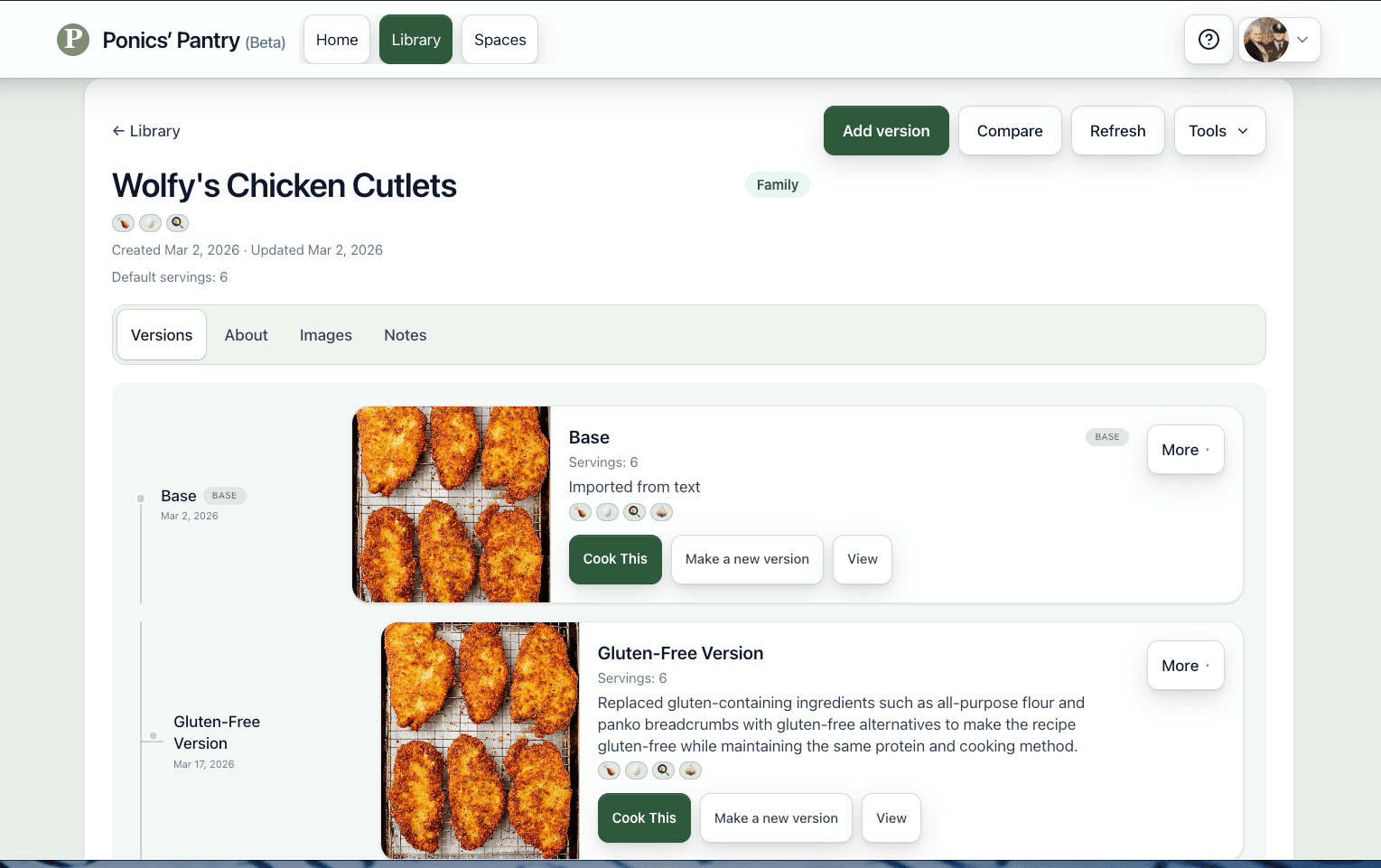
Recipe families keep every version connected.
Shared Spaces keep kitchen circles connected
Shared Spaces are where families, friends, tailgate crews, creators, and kitchen teams build living cookbooks together.
Inside a Shared Space, recipes can be shared, discussed, forked, cooked, and remembered without giving up each person’s own library.
Events take that one step further. Create a gathering inside a Shared Space — a holiday, beach week, tailgate, reunion, camp weekend, popup meal, or community dinner — and connect the menu to exact recipe versions.
Shared Spaces Events can help you keep:
- the date, organizer, attendees, and RSVP
- the exact recipe versions on the menu
- scaled servings and group shopping
- tasks, ownership claims, and overdue items
- event-specific chat
- photos, recap memories, and standout dishes
- a cloneable history for the next gathering
That is what makes it different from planning software. Ponics’ Pantry does not just help organize the next meal. It helps preserve the lore around the gatherings people want to repeat.
Why it is different
Ponics’ Pantry is built around structured recipe data, version lineage, and selective AI assistance. That gives it a different foundation from ordinary recipe storage apps.
Version-native from the start
Recipes are built as families of versions, not single cards that get overwritten.
Structured data, not blobs
Ingredients, steps, tags, notes, versions, and provenance stay structured so the product can compare, scale, shop, and reason more clearly.
AI where it helps, not everywhere
Ponics’ Pantry uses deterministic rules and catalogs first, then uses AI selectively for bounded tasks like import rescue, creation, substitutions, image generation, and recipe reshaping.
Food connected to real life
Recipes can connect to cooks, gatherings, memories, photos, events, and outcomes — the context that makes a cookbook worth keeping.
Built for the moment you are actually cooking
Ponics’ Pantry is not only for preserving recipes. It is built for the practical moment when dinner has to happen.
Use Kitchen Mode, generate shopping lists, mark pantry staples, keep cook notes, branch from what worked, and return to the version that made the dish better.
For serious cooks, cook telemetry templates can capture the details that matter — smoker checkpoints, proof times, bake results, sauce changes, prep notes, or other structured outcomes tied to a version.
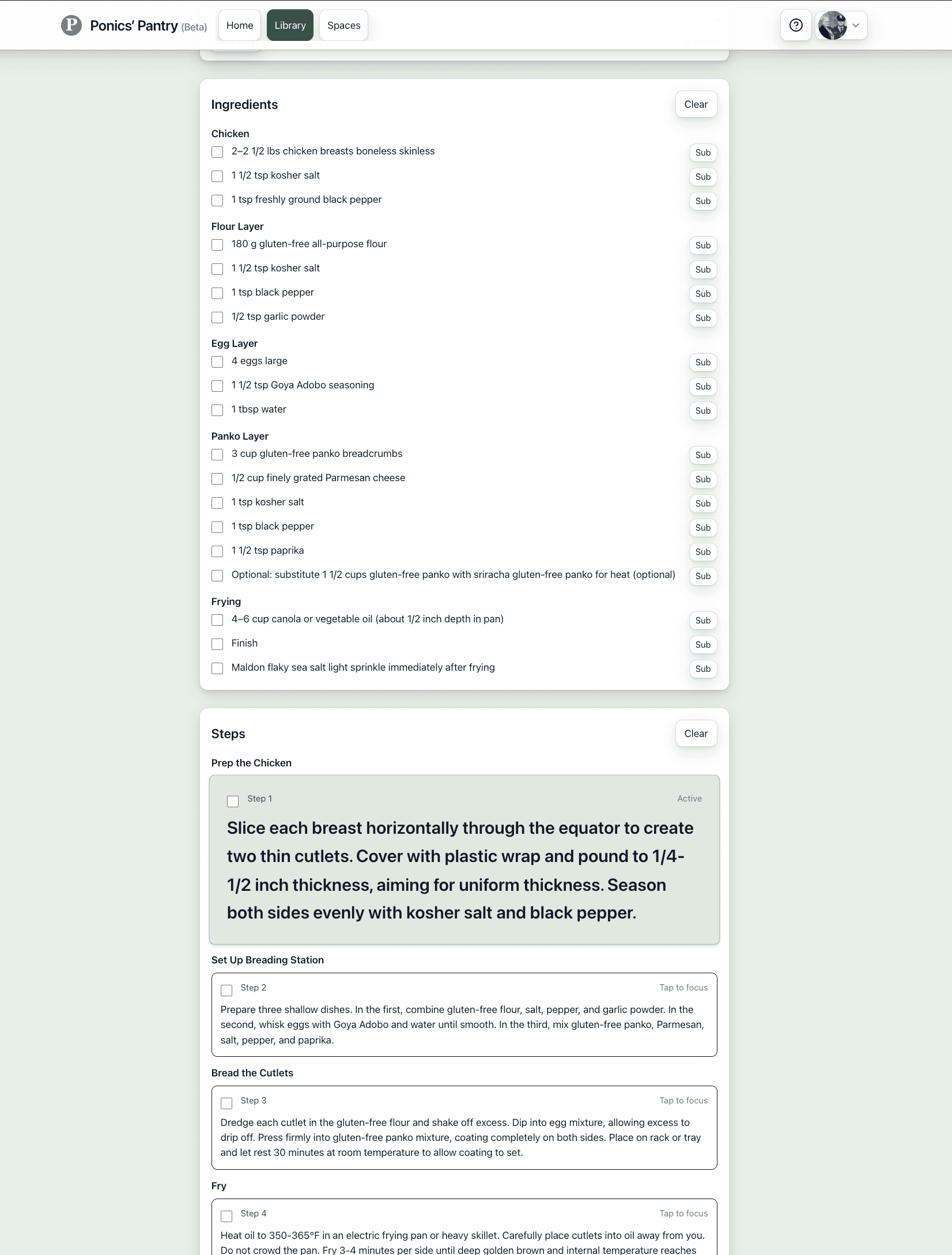
Kitchen Mode keeps the recipe connected to the cook, not just the archive.
Who it is for
Ponics’ Pantry can stay simple or become a serious cooking system depending on how you cook.
Everyday home cooks
A clean place to store, import, cook from, and improve the recipes you already use.
Good starting tier: Home Cook
Families and recipe keepers
Preserve inherited recipes, family branches, memories, and traditions across generations.
Good starting tier: Home Cook, with Serious Cook for deeper contribution
Dietary and health-focused cooks
Create safe or goal-driven versions for gluten-free cooking, higher protein goals, lower sodium, or other real constraints.
Good starting tier: Serious Cook
BBQ, smoker, pizza, bread, and fermentation cooks
Track experiments, compare outcomes, and keep the exact version that finally worked.
Good starting tier: Serious Cook, with Kitchen Lab for deeper telemetry
Tailgate crews, lake houses, and recurring groups
Use Shared Spaces Events to plan the menu, assign tasks, remember the story, and clone the tradition next time.
Good starting tier: Home Cook for participants, Serious Cook for organizers
Creators and community cooks
With Recipe Creator, publish living recipe collections your audience can fork, cook, and keep evolving.
Good starting tier: Recipe Creator
Restaurants and kitchen teams
Preserve working recipes, track improvements, and keep the team aligned around the version that should be made.
Good starting tier: Kitchen Lab
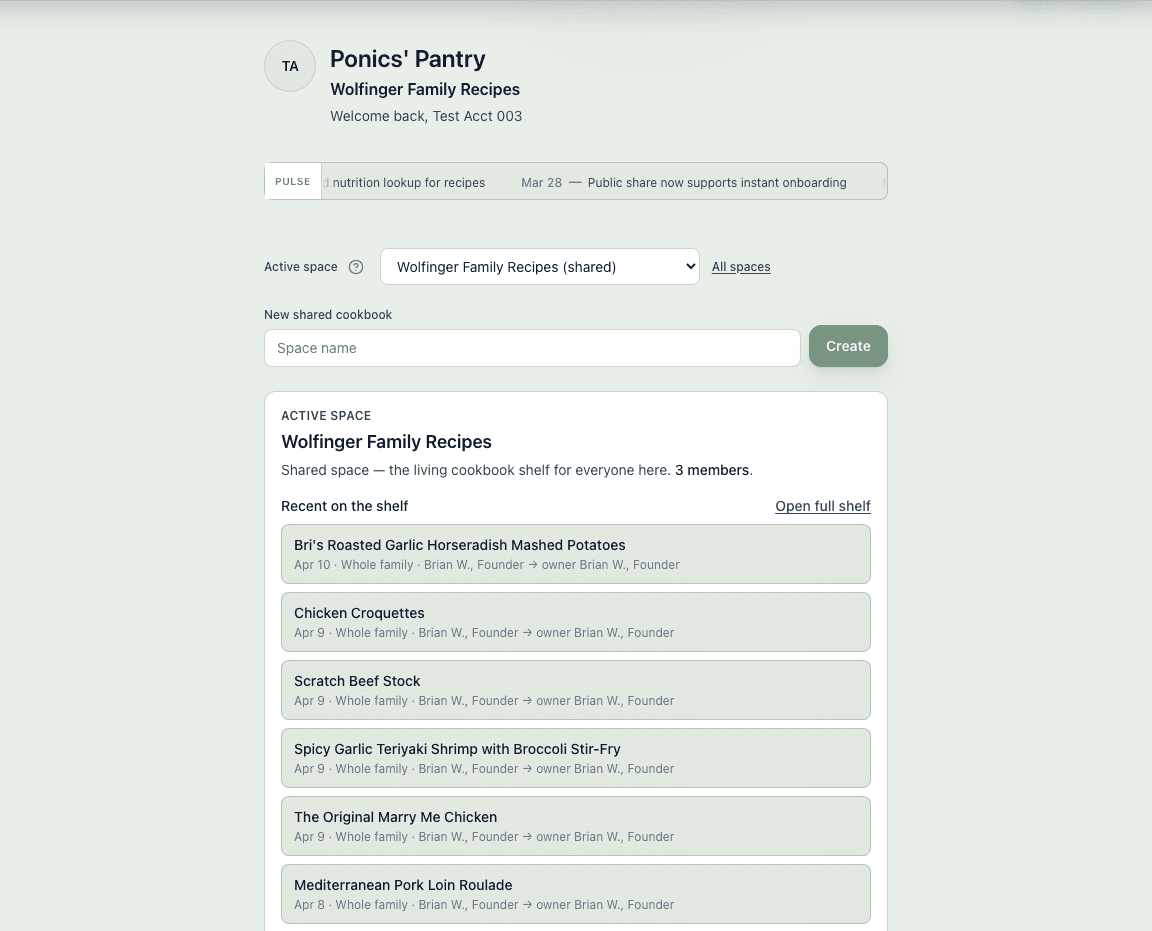
Your recipes, versions, shared spaces, and cooking history stay connected.
Simple, transparent pricing
Start free with Home Cook. Paid plans begin at $5.99/month.
No surprise pricing after account creation.
Home Cook
Free
Serious Cook
$5.99/month
Recipe Creator
$10.99/month
Kitchen Lab
$17.99/month
See one recipe evolve
A real chicken cutlet recipe from our kitchen became a family of versions: original, gluten-free, Milanese-style, merged, and lighter baked.
Built for the kitchen. Mobile apps are coming.
Ponics’ Pantry already works in the browser, including on phones and tablets.
The product is also being prepared for iPhone and Android through a mobile app shell, so the same recipe, event, shopping, and cooking workflows can feel even more natural in the kitchen.
No App Store claims yet — just the same product moving toward the place people actually cook.
Giving back
Ponics’ Pantry donates 5% of subscription revenue to support No Kid Hungry.
It is a company contribution from paid subscriptions, not an add-on or checkout prompt.
Food is memory, tradition, comfort, and community. It should also be something more children can count on.
Start your living cookbook
Bring in the recipes you already have, create the versions you actually cook, and keep the gatherings and memories that make them worth repeating.
Start free with no card required. Paid plans begin at $5.99/month.